Chevy small-block: the V8 that would not die
One of the most famous numbers in American hot-rodding started in a Camaro, not a Corvette. The number is 350.
Re-checked Oct 6, 2026 against Chevrolet Performance's small-block timeline and GM's Sept. 17, 2026 sixth-generation small-block release.
One of the most famous numbers in American hot-rodding started in a Camaro, not a Corvette. The number is 350.
What the number means
In plain English, 350 is cubic inches, about 5.7 liters. That is displacement: the total space the pistons sweep in all eight cylinders as they travel up and down. Bigger number, bigger gulp of air and fuel every time the engine turns over, and usually more power and torque.
Where the small-block came from
Chevrolet Performance’s own timeline starts in 1955, when GM and Chevrolet released the original small-block V8, a 265-cubic-inch engine fitted to the Corvette. In 1957 Chevrolet stretched it to 283 cubic inches for the Super Turbo-Fire V8, reaching one horsepower per cubic inch. In 1962 came the 327, as a more powerful option for the Corvette.
GM says one measurement has stayed put through more than 100 million small-blocks since 1955: the middle of each cylinder sits 4.40 inches from the middle of the next. It is the one number every small-block shares.
The Camaro got it first
Chevrolet’s answer to the Ford Mustang, the 1967 Camaro, gets the credit in that timeline for the first 350 V8. The Corvette, Chevy’s flagship, had to wait until 1969, when the 350 replaced its 327. Imagine being the flagship and getting the pony car’s hand-me-down.
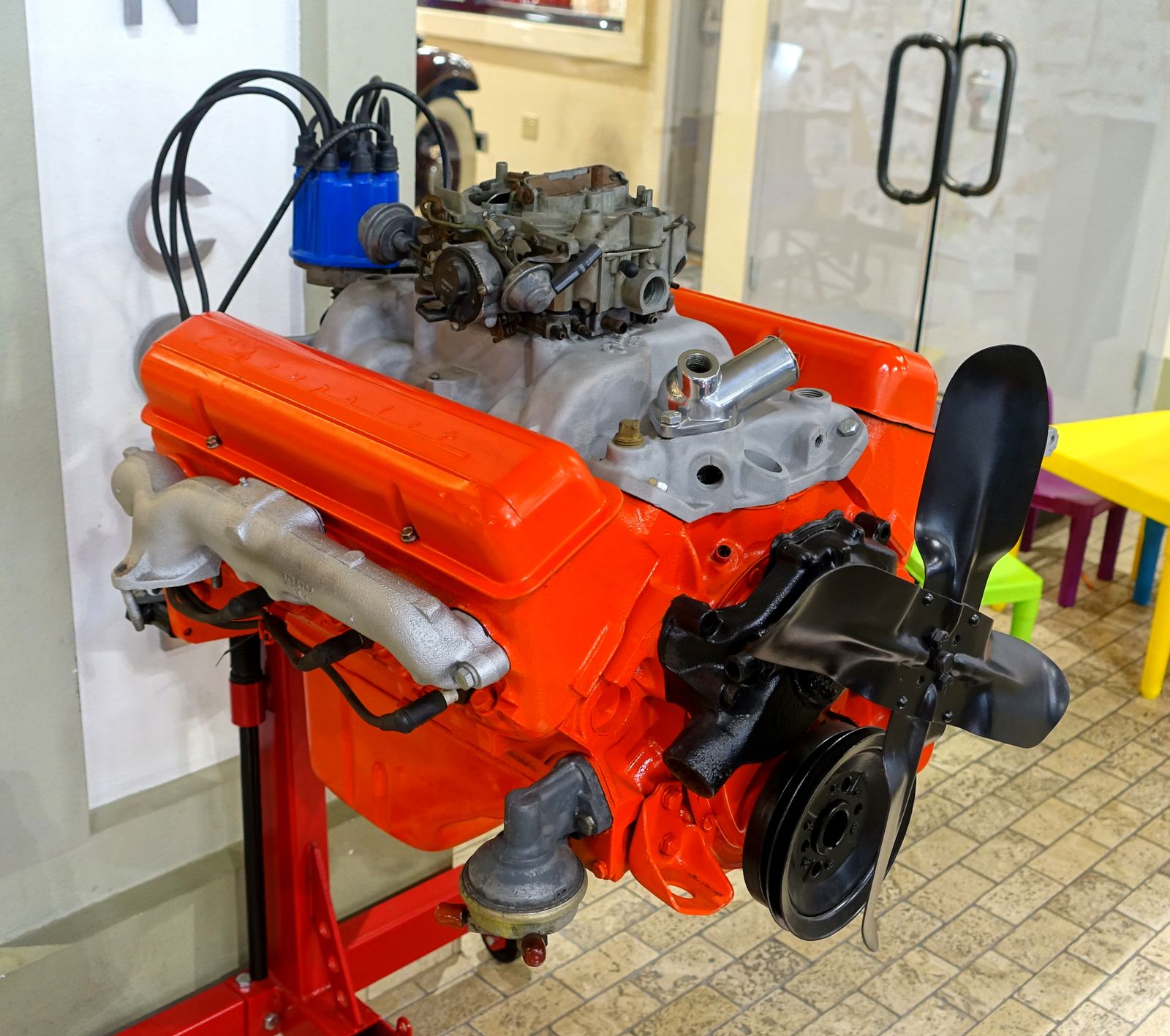
The 350 kept evolving after that. In 1970 Chevrolet introduced the LT1 version for the Corvette and Camaro Z28. In 1985 the L98 350 got tuned port fuel injection for Camaros, Firebirds and Corvettes, which is a long way from a carburetor like the one on the engine in our photo.
Back for 2027
On September 17, 2026, GM announced its sixth-generation small-block for the 2027 Chevrolet Silverado 1500 and GMC Sierra 1500. The L76 is 5.7 liters, 350 cubic inches, and GM’s own release says it heralds the return of the 350. GM got there by lengthening the piston stroke, meaning how far each piston travels, by 6 mm compared with GM’s current 5.3-liter truck V8.
GM rates the L76 at 402 horsepower and 428 lb-ft of torque, and says a properly equipped Silverado 1500 with it can tow up to 13,700 pounds. Its bigger sibling, the L78, brings back 400 cubic inches as a 6.6-liter with 481 horsepower. Both feed fuel two ways, with direct injection and port injection, and the first engines are built at GM’s Flint Engine Operations.
Fifty-nine years after the first one, the number still sells. This time it went into a pickup truck, not a pony car.
What did you put a 350 in, or what do you wish you had?