Volvo’s seat belt was perfected by an ejection-seat engineer, then given away
The man who perfected the modern seat belt used to work on ejection seats for airplanes. Then his employer, Volvo, gave the design away for free.
Bohlin's background, the 1959 date, the belt layout, the Aug. 13, 1959 delivery, the 1963 U.S. launch, the free patent and the million-lives estimate checked against Volvo Cars Media US (Aug. 12, 2009) and Volvo Group Heritage, on Oct. 20, 2026.
The man who perfected the modern seat belt used to work on ejection seats for airplanes. Then his employer, Volvo, gave the design away for free. It is one of the few stories in the car business where the most generous move and the smartest one turned out to be the same thing.
The engineer from the ejection seats
His name was Nils Bohlin. Before he joined Volvo, he was an aviation engineer who worked on catapult seats, the kind that fire a pilot out of a failing aircraft. So he arrived already knowing a great deal about what a sudden stop does to a human body.
Seat belts were not new. Volvo’s own heritage history points out that belts of one kind or another had been around since the mid-1800s, and plain lap belts already helped. Then, in the 1950s, a new belt prototype reached Volvo and landed on Bohlin’s desk. In 1959 he got it right.
Why three points
The design is the one you wear every day. One strap runs across your lap and one runs across your chest, and they meet at an anchor low beside the seat, in a V that points to the floor. Volvo’s explanation is simple: the belt spreads the force of a crash across your pelvis and chest, where the body is strongest. Bohlin’s patent puts it in drier words. It says the belt keeps the wearer’s body from being thrown forward “effectively, and in a physiologically favorable manner.” Engineers, it seems, never write “it stops you hitting the dashboard.”
The first car to get it
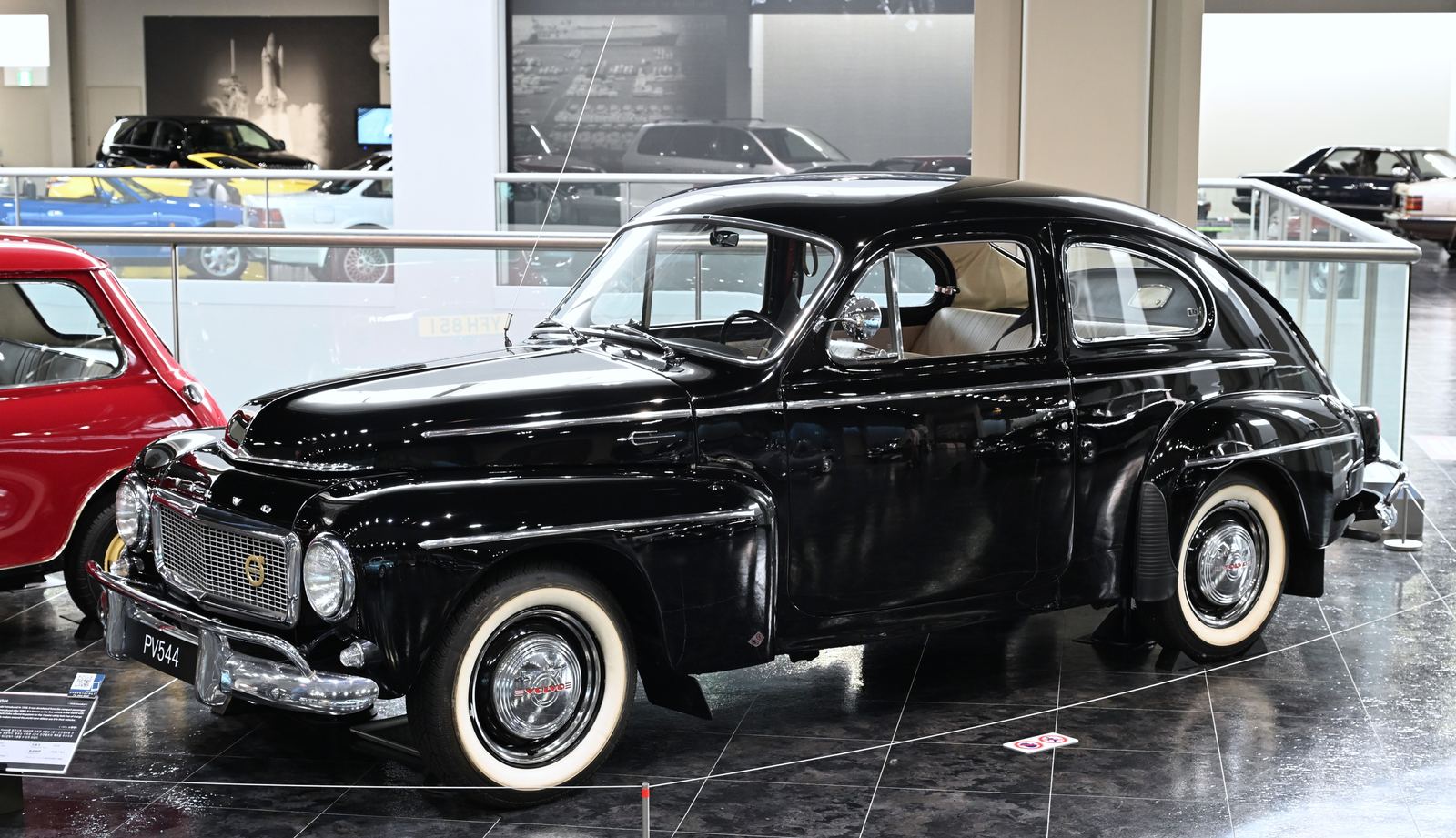
On Aug. 13, 1959, Volvo delivered the first car with three-point belts as standard to its dealer in Kristianstad, Sweden. It was a PV544, the rounded little sedan in the photo above. Before long the belt was standard in every Volvo, and in 1963 Volvo launched it in the United States.
The part that still sounds made up
Volvo patented the design and then let every carmaker use it without payment. Volvo Group’s heritage page says the belt was “gifted to the rest of the industry,” and today it sits in most of the cars on the road, whoever built them, with its use required by law in much of the world.
Volvo estimates the three-point belt has saved more than a million lives. That figure is Volvo’s own estimate, not an independent count, but the basic idea behind it is hard to argue with. Somewhere, a patent lawyer is still wincing at the royalties that never were.
Volvo has long said that safety is the starting point for everything it builds. Its founders wrote in a 1936 sales handbook that “an automobile is driven by people,” and that safety must be the basic rule for all design work. A free seat belt is about the clearest proof of that line anyone could ask for.
So, honest question: do you buckle up before you start the car, or after the chime starts nagging?