The Smithsonian’s 1986 Dodge Caravan
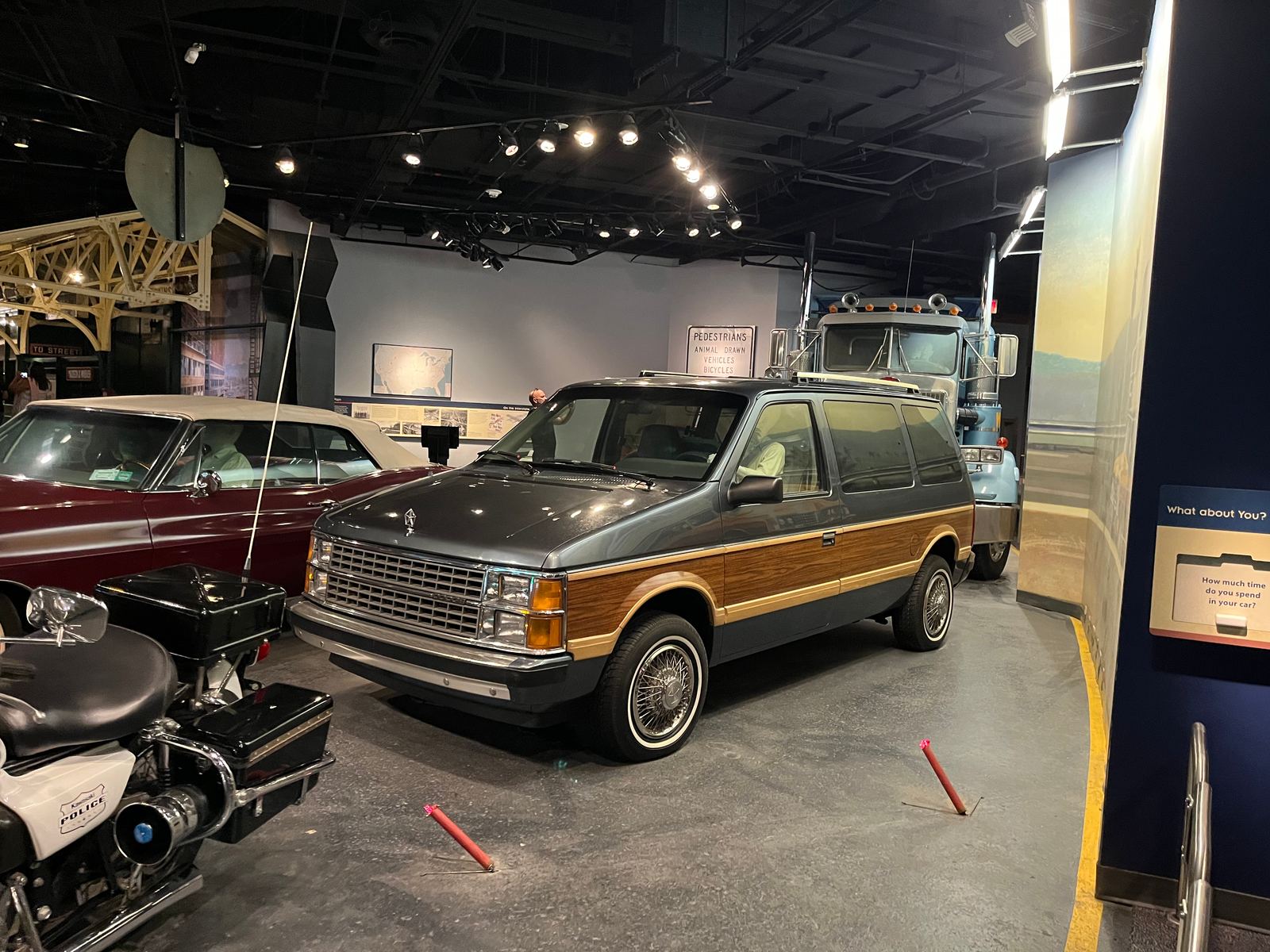
Look at the driver’s side. One door. That is why this woodgrain Caravan belongs in a museum.
Re-checked Oct 8, 2026 against the Smithsonian NMAH object record nmah_1305102 and Stellantis North America minivan timeline (news release id=8236). Daughter's name omitted on purpose. "Dozen model years" is arithmetic from the 1984 model year through 1995 before the 1996 driver-side sliding door.
Look at the side of this 1986 Dodge Caravan facing you. One door.
That is the driver’s side. Chrysler’s minivans did not get a second sliding door there until 1996. For a dozen model years before that, getting to the way back meant climbing over a sibling. The woodgrain paneling is period-correct. The museum setting is not a joke. This van is on display at the Smithsonian.
Why a family van is in a museum
The Smithsonian’s National Museum of American History keeps it in the America on the Move gallery. The object record says Fred and Maryann Knoche of Warren, Michigan, bought the Caravan because their car was too small for family vacations. They drove it from 1986 to 2001. Maryann used it to haul her daughter’s softball team to practice and games.
That is the whole pitch of the early minivan in one family’s story: not stylish, long on utility, and suddenly the default way American kids got to where they needed to go.
What made it different from a full-size van
In plain English, the breakthrough was packaging. The engine sits up front and drives the front wheels. There is no long driveshaft running down the middle of the floor to a rear axle, so the floor can stay flat. You step in like a car instead of climbing up into a cargo van.
Stellantis’s own minivan timeline calls the first ones the T-115 and describes them as the first front-wheel-drive small vans. Friends and family, the company wrote, stepped into them like a car rather than climbing up into a full-size van. Chrysler Chairman Lee A. Iacocca marked the first one off the line at Windsor Assembly Plant in Ontario, Canada, on Nov. 2, 1983. The Dodge Caravan and Plymouth Voyager followed into the market for the 1984 model year.
The missing door
The photo is the punch line. On the driver’s side you see one ordinary front door and no slider. The passenger side had the sliding door. For years that was enough, until it wasn’t. In 1996 Chrysler introduced its third-generation minivans on the NS platform with a U.S. first: a driver-side sliding door, so both sides of the cabin opened the same way. Suddenly “climbing over a sibling” stopped being a design feature.
A dozen model years is the span from the early vans through 1995, before that second slider arrived. Arithmetic, not poetry.
Short on style. Long on utility. Still the easiest way to start an argument about who had to sit in the way back.
Who rode back there, and what was the rule?