Street HEMI: the 426 Chrysler sold because NASCAR made it
Chrysler did not build the Street HEMI because customers begged. It built it because NASCAR said no.
Facts from the Oct. 6, 2026 fact-check of the Facebook post: Stellantis HEMI heritage release id=739 (1964 Daytona result, 1966 models, 425 hp) and the NHRA feature of Feb. 15, 2026 (1965 rule, Barracuda, 1966 Daytona and the NHRA hat). Production counts left out (secondary sources only).
Chrysler did not build the Street HEMI because customers begged. It built it because NASCAR said no.
A race engine you could not buy
In 1964 the 426 HEMI was a race-only engine. You could not walk into a dealer and order one in a car. It went to Daytona anyway, and it won the 1964 Daytona 500. Stellantis’s own history says HEMI cars finished first, second and third.
NASCAR’s answer for 1965, as the NHRA tells it: if an engine was not available in a car sold to the public, it could not race. That rule has a name, homologation. In plain English, prove you sell it, then you can race it. Stellantis puts it more politely, saying NASCAR quickly imposed stricter engine specifications.
A season in a straight line
So Chrysler sat out. With Chrysler sidelined from NASCAR, Richard Petty spent much of 1965 drag racing instead, in a Barracuda with a mechanically injected 426 HEMI, per the NHRA. The engine that had just swept Daytona spent the year going in a straight line.
The expensive fix
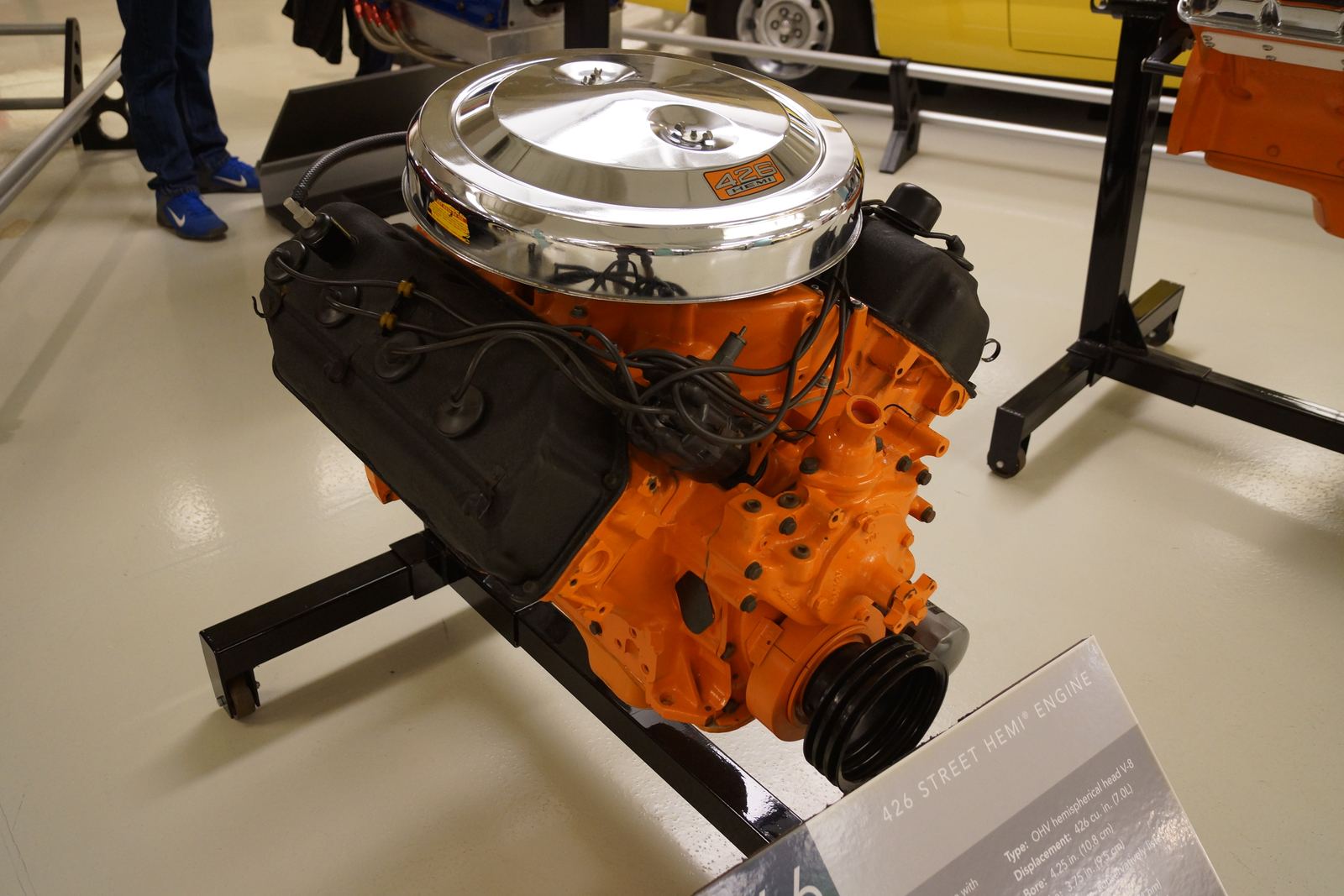
Then Chrysler did the expensive thing. For 1966 it offered a slightly tuned-down 426 in showroom cars: the Plymouth Belvedere, the Dodge Coronet and the Dodge Charger. Chrysler advertised it at 425 horsepower. That is the Street HEMI, and that is the engine in the photo.
For a buyer, it meant you could order, in a family-size car, a close relative of the engine that won Daytona, with some of the edge filed off for the street. For NASCAR, it meant the HEMI was now an engine the public could buy, which was the whole point of the rule.
Back to Daytona
Petty went back to Daytona in 1966 and won the 500. In Victory Lane he wore an NHRA hat. Subtle.
What is in the picture
The photo shows a 1966 426 Street HEMI on a display stand at the Walter P. Chrysler Museum, taken in December 2016. It is the street engine, not a race engine: orange block, black valve covers and a chrome air cleaner with a 426 decal, in case anyone at the cruise night asks how you can tell.
If you want to know what the HEMI name actually means, our Reel on the engine and its rounded combustion chambers is on the Video page.
Would you have ordered the HEMI just to get Petty back?