Ford Flathead V8: the cheap V8 that changed the street
In 1932 Ford put a V8 in a car ordinary people could buy. That sidevalve engine is still the one hot-rodders mean when they say flathead.
Figures limited to The Henry Ford artifact page for V-8 engine No. 1 (artifact 100456), re-checked Oct 4, 2026.
In 1932 Ford put a V8 in a car ordinary people could buy. That sidevalve engine is still the one hot-rodders mean when they say flathead.
The Henry Ford museum holds V-8 engine No. 1 from that program. According to the museum’s artifact record, it is a 221-cubic-inch L-head V8 rated at 65 horsepower at 3,400 rpm, made by Ford Motor Company in Dearborn, Michigan, and dated 1932.
One casting, one bargain
Henry Ford and Ford Motor Company had already remade the industry once with the Model T. They did it again in 1932 with a low-priced V8. The museum’s overview is blunt about the manufacturing trick: by casting the crankcase and cylinder banks as a single unit, Ford cut costs and could offer the V8 in a car starting under $500.
That is the whole point of this engine. It was not a racing special or a coachbuilt oddity. It was a V8 you could buy with regular money, then take home and, later, take apart.
Long-lived by design
Ford’s original V8 design remained in production, with modifications, until 1953. That is more than two decades of the same basic idea: an L-head V8 that was simple enough to build in volume and durable enough to keep selling while other makers chased higher peak horsepower.
The museum groups engine No. 1 with its Post-Model T Henry Ford set for a reason. After the Model T, the next big democratizing move was not another four. It was a V8 priced for the same customers who had bought Fords before. Casting the block as one piece was the production answer that made that price possible.
It was never the most powerful American V8. Peak power was not the product. Affordability was. The museum’s numbers on engine No. 1, 221 cubic inches and 65 horsepower at 3,400 rpm, are modest by later standards. They were enough to put eight cylinders under the hood of a car that started under $500, and that was the revolution.
What the photo is (and is not)
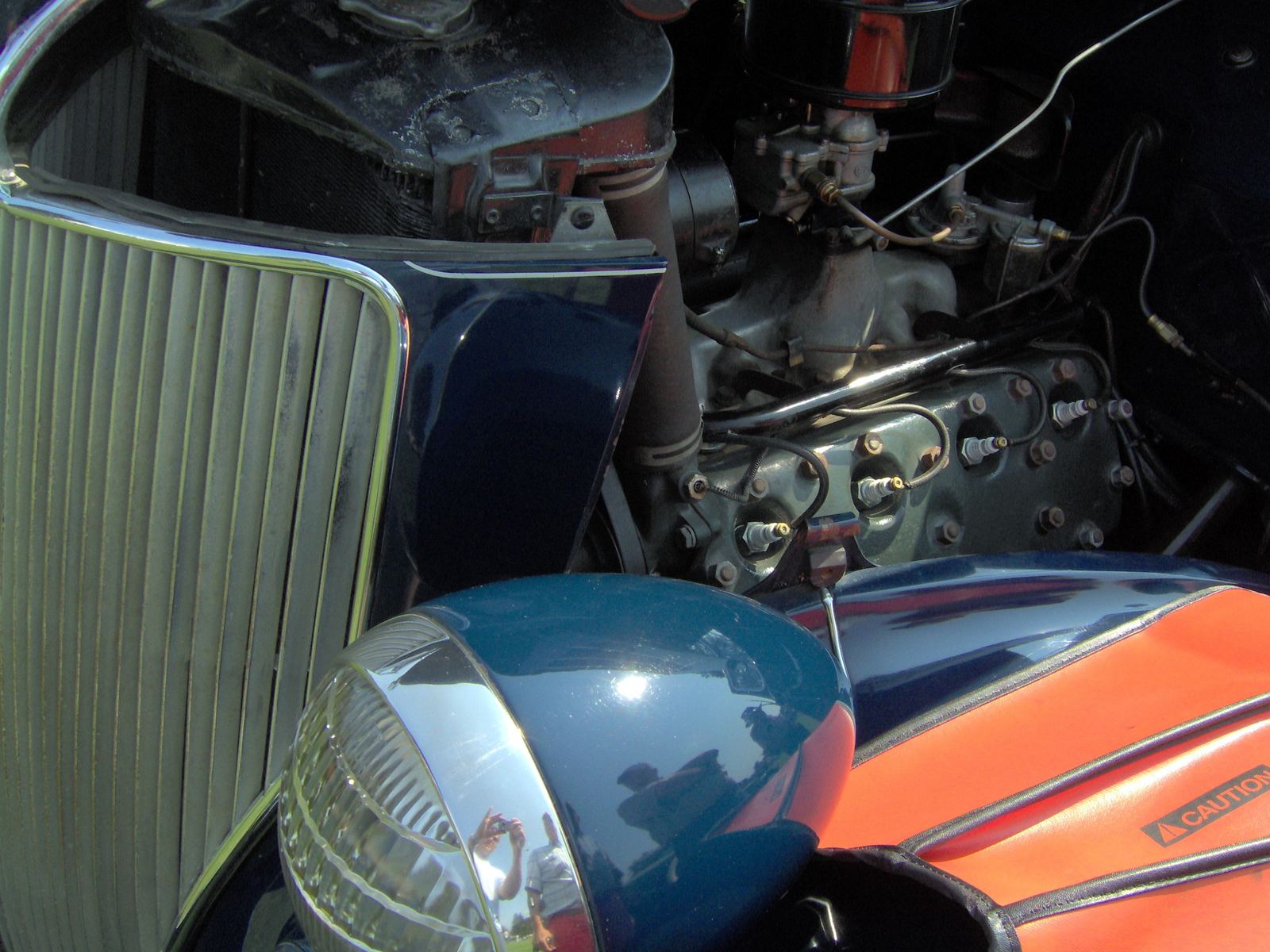
The photo on this page is a 1936 Ford convertible flathead V8 in an engine bay, credited to Stephen Foskett via Wikimedia Commons under CC BY-SA 3.0. It is not engine No. 1. The copy does not claim it is. It is the shape hot-rodders still point at when they say flathead: sidevalve, low, and unmistakeable once you have seen one.
A lot of American car culture still runs on that bargain. The V8 that mattered was the one you could afford, modify and hear coming down the street. Engine No. 1 is sitting in a museum. The idea never really left.